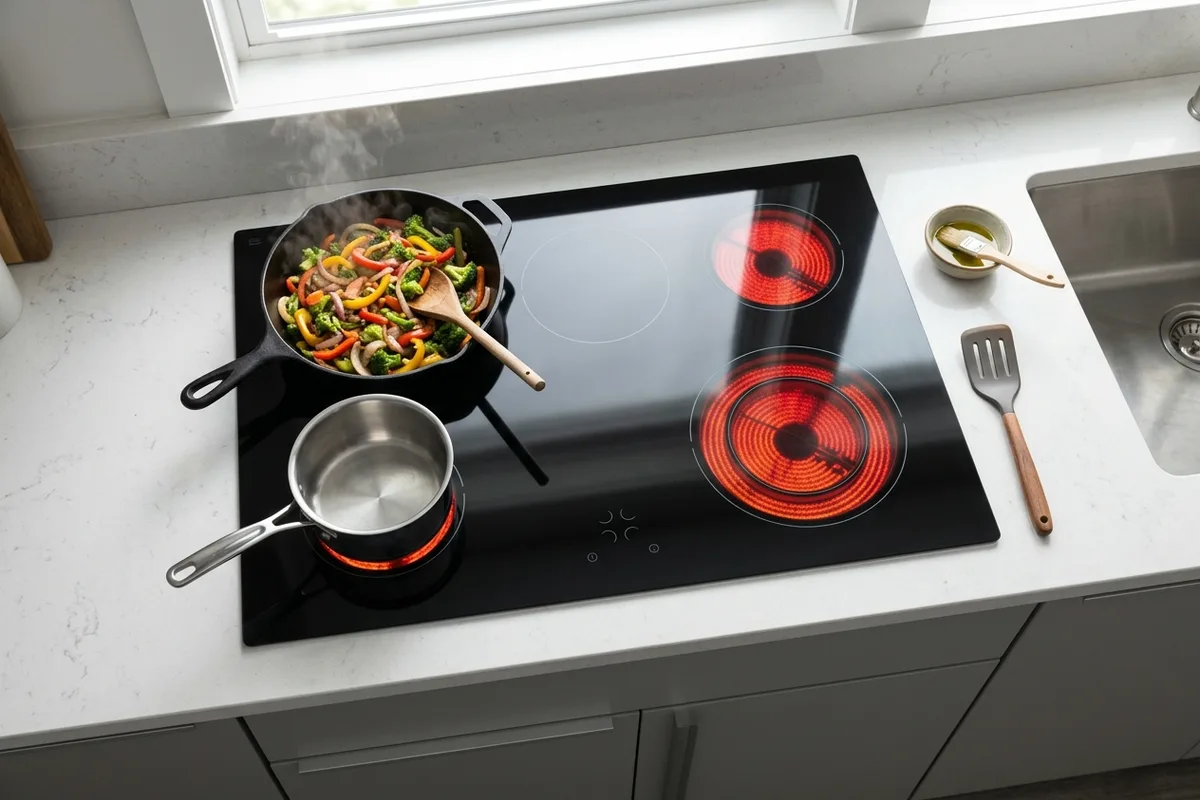
Stoves and cooktops come in two fundamentally different forms, and the form decides almost everything about how disposal works. A freestanding range — the tall unit with burners on top and an oven below — slides out from between the kitchen cabinets and leaves on a trolley. A built-in cooktop — the flat panel recessed into the worktop — lifts out of a cutout and leaves as a slab of glass and steel. The disconnection, the tools, the time, and the precautions are different for each. Both are collected as appliance removal in Dubai; the difference is who disconnects them and when.
Freestanding Ranges: Gas, Electric, and Dual-Fuel
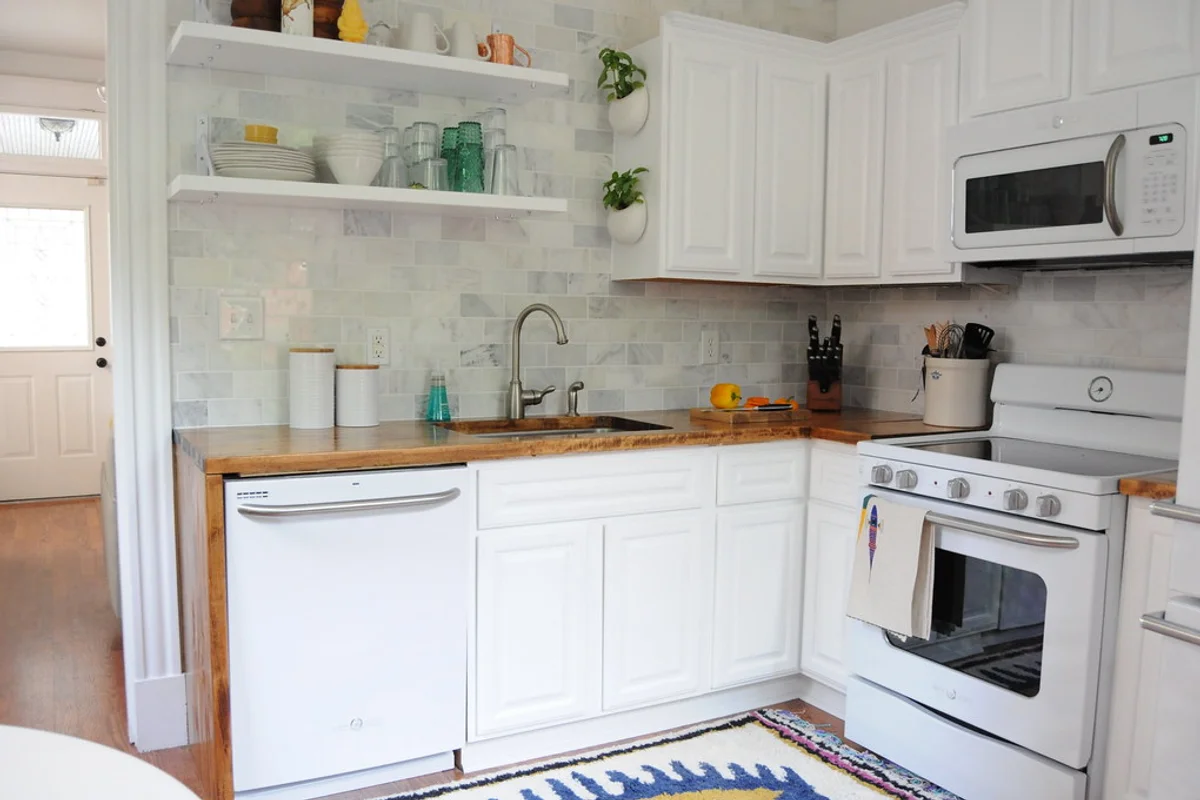
A freestanding range is the most common cooking appliance in villa kitchens and older apartment buildings in Dubai. It sits between two base cabinets, usually held in place by its own weight and a set of adjustable feet. Pulling it forward exposes the connections at the back: a gas bayonet or flexible hose on a gas model, a heavy-duty power cable on an electric model, or both on a dual-fuel unit.
Gas Ranges
A gas range connects to the building's piped gas supply (in apartments with centralised gas) or to a portable LPG cylinder (common in villas and older buildings). The connection is a flexible stainless-steel hose with a threaded coupling at the wall end. Disconnecting it requires closing the isolation valve at the wall, unscrewing the coupling, and capping the open pipe end. This is licensed work — gas isolation and capping should be carried out by a qualified technician, not by a general removal crew.
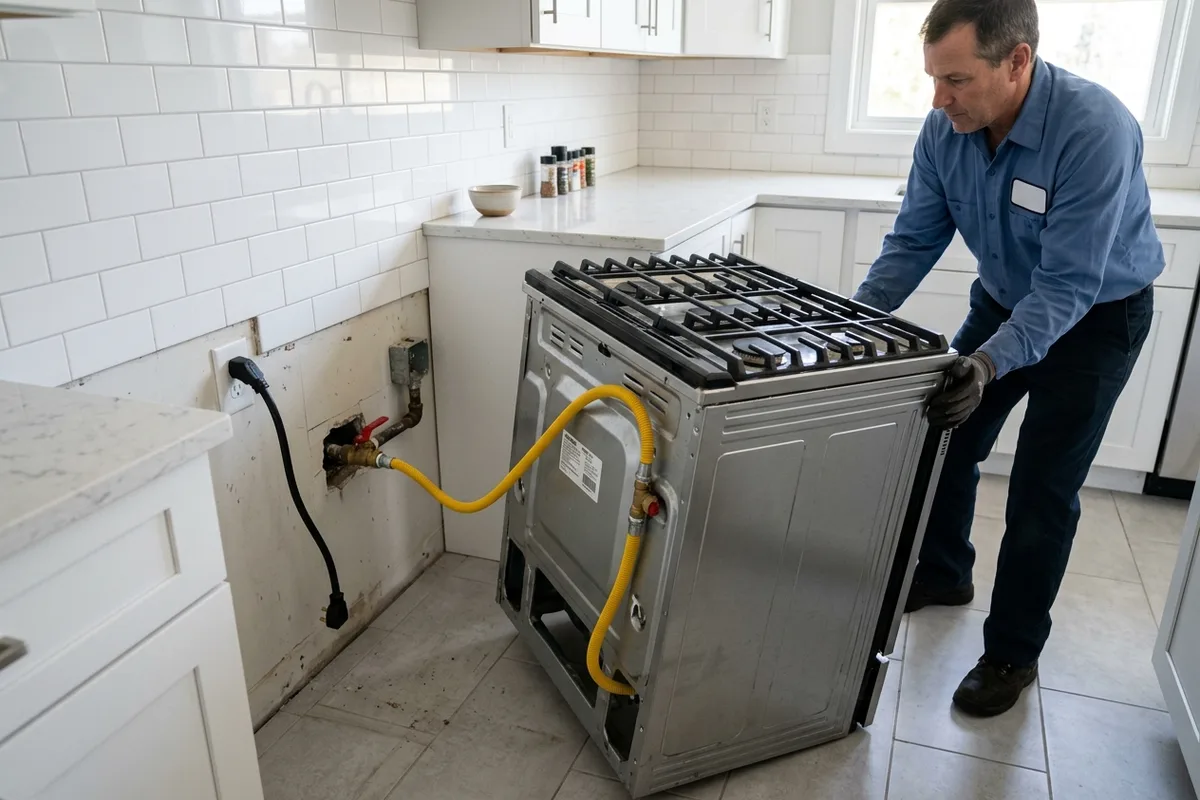
Once disconnected, a gas range is simply a heavy steel box. Most weigh between 50 kg and 80 kg. The cast-iron pan supports and the oven door add weight at the top and front, making the unit front-heavy when tilted for a trolley. Removing the pan supports and the oven racks before moving reduces the risk of loose parts sliding off during the carry.
Electric Ranges
An electric range is connected to a dedicated high-amperage circuit — usually 32A or 45A in Dubai — via a heavy cable that runs to a dedicated consumer unit or a cooker connection point behind the appliance. The cable may be hardwired into a terminal block at the back of the range or connected through a cooker plug and socket. Hardwired connections must be isolated at the consumer unit and the cable freed from the terminal block. A cooker plug simply pulls from its socket once the circuit is switched off at the isolator.
Built-In Cooktops: Ceramic, Induction, and Gas Hobs
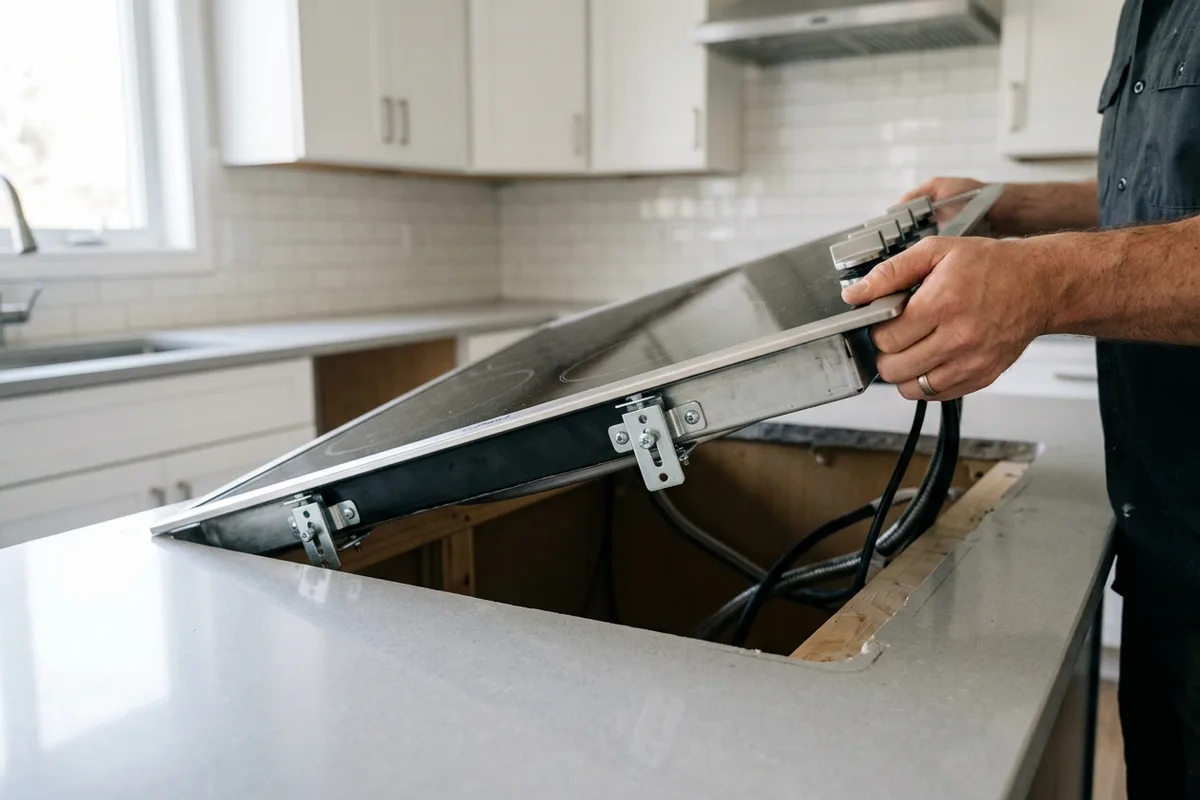
A built-in cooktop sits in a rectangular cutout in the kitchen worktop and is held in place by mounting clips underneath. The electrical cable or gas hose drops down through the cutout and connects below the counter. Removing the cooktop means disconnecting from below, releasing the clips, and lifting the panel straight up out of the cutout.
Ceramic and Induction Hobs
Both are glass panels — a ceramic hob with radiant elements beneath and an induction hob with copper coils. They are fragile, heavy relative to their thinness, and connected to a high-amperage circuit in the same way as an electric range. The glass panel is the handling risk: it can crack if twisted during lifting, and the edges are often sealed with a silicone bead to the worktop surface. Breaking the silicone seal cleanly — a utility knife run around the perimeter — is the first step before the clips are released.
Once free, the panel should be carried flat and face-up, never stood on its edge. A ceramic or induction hob travels to the vehicle on its back, cushioned, exactly like a pane of glass.
Built-In Gas Hobs
A gas hob in a countertop cutout connects to piped gas through a flexible hose under the worktop. The same rules apply as for a freestanding gas range: the isolation valve must be closed, the hose disconnected, and the open pipe end capped by a qualified person. The hob itself is lighter than a range — typically 8–15 kg — so lifting it out of the cutout is straightforward once the gas is isolated.
Cooktop Only, or Cooktop and Oven Together?
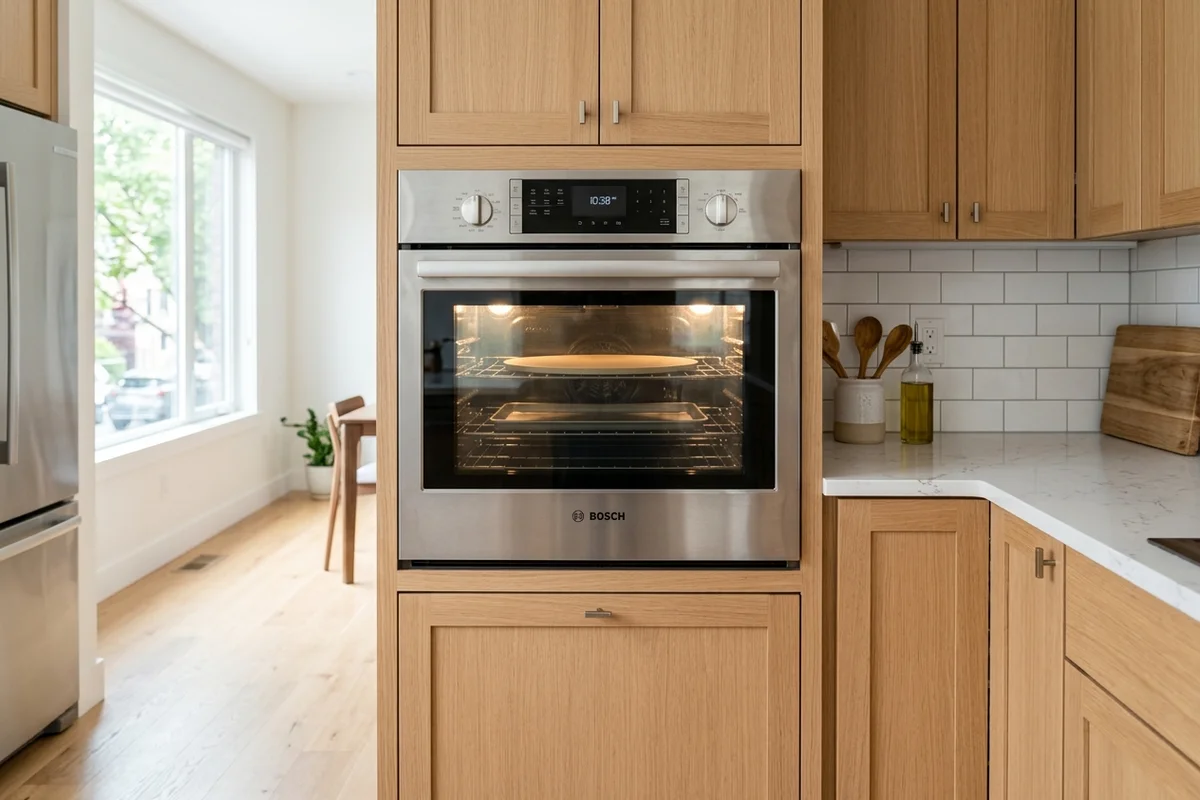
In kitchens with a built-in cooktop, the oven is usually a separate wall-mounted or under-counter unit. The two are independent appliances on separate circuits. Disposing of the cooktop does not require removing the oven, and vice versa. If both are going, they are two separate disconnection jobs and two separate items on the vehicle — one glass panel and one heavy steel box.
A freestanding range is a single unit: the cooktop and the oven are one appliance, so replacing or disposing of the range always means dealing with both at once. This is worth knowing when comparing quotes, because a built-in kitchen generates two line items where a freestanding kitchen generates one.
What to Check Before Booking
- **Fuel type.** Gas, electric, or dual-fuel? Gas disconnection requires a qualified technician and may need to be arranged separately from the removal itself.
- **Freestanding or built-in?** This determines whether the appliance slides out or lifts out, and whether worktop seals or mounting clips are involved.
- **Is it landlord property?** In many Dubai rental apartments, the kitchen appliances are part of the landlord's fit-out. Removing them without written consent from the landlord or management company creates a deposit liability. Check the tenancy inventory first.
- **Hood and extractor.** A cooktop often has an extractor hood or downdraft unit directly above or behind it. Confirm whether the hood is staying or going — it is a separate appliance with its own wiring and ductwork.
- **Counter condition.** A built-in cooktop leaves a large rectangular hole in the worktop. If you are replacing the cooktop, the cutout dimensions need to match the new unit. If not, the hole either needs covering or the worktop section may need replacing — that is a kitchen fitter's job, not a removal crew's.
What Happens to a Stove or Cooktop After Collection
A freestanding range is predominantly steel — the carcass, the oven cavity, the pan supports — with smaller quantities of glass (the oven door), electronics (the ignition module or digital timer), and potentially copper from the heating elements. The steel is separated and recycled as ferrous scrap. The glass and electronics are directed to the appropriate processing streams.
A ceramic or induction cooktop is a glass panel bonded to a steel chassis with electronic controls and heating elements beneath. The glass is the largest component by area but not by weight; the chassis and the coils carry most of the recoverable material. Induction hobs contain copper coils, which have a higher scrap value than the steel. Gas hobs are mostly steel and cast iron, with brass fittings at the gas connection.