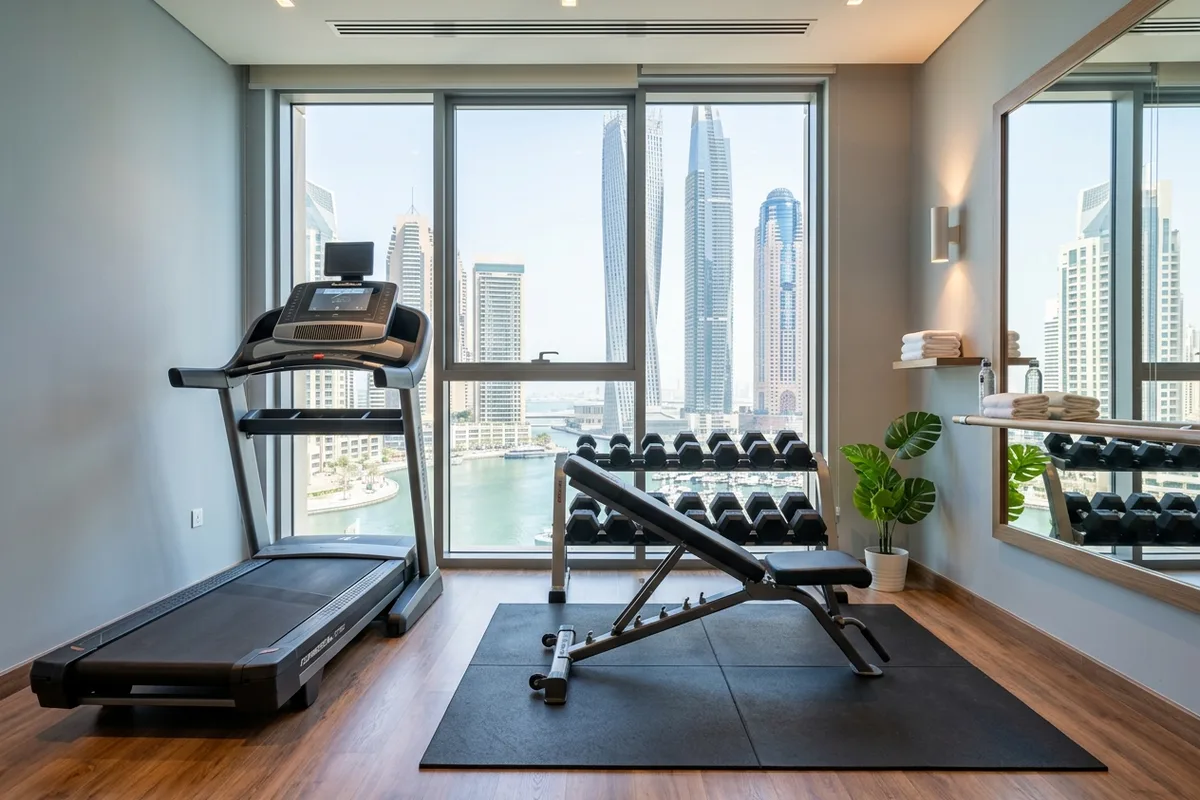
A home gym sounds like a good idea until you need to get rid of it. The treadmill alone can weigh well over a hundred kilograms, the weight plates are pure cast iron, and the rubber matting is glued or interlocked across the entire floor. Removing gym equipment from a Dubai home is a weight-and-access problem first and a logistics problem second, and what applies in a villa garage is very different from what applies on the twenty-third floor of a tower.
Why Gym Equipment Is a Different Kind of Removal
Most household items are bulky but relatively light, or heavy but compact. Gym equipment is often both at once. A multi-station home gym can weigh several hundred kilograms fully assembled and stand over two metres tall, but it cannot be moved in one piece because it was bolted together in the room. A loaded dumbbell rack is compact enough to fit through a doorway but far too heavy for two people to carry safely down a corridor.
The other difference is density. A sofa the same size as a treadmill weighs a fraction of it. Density changes the vehicle calculation — gym equipment fills a truck by weight long before it fills it by volume, and some items (a full set of Olympic plates, for example) can approach the load limit of a light commercial vehicle on their own.
The Common Items and What Each One Involves
Treadmills and Elliptical Trainers
A motorised treadmill is the single heaviest item in most home gyms. The motor, the steel frame, and the running deck combine to make a unit that routinely weighs between 80 kg and 140 kg. Some fold — the deck lifts vertically on a hydraulic piston — which reduces the footprint but not the weight. An elliptical trainer is lighter but wider and more awkward, with pedal arms that swing and handlebars that protrude beyond the frame.
Both are electrical items. The treadmill plugs into a standard 13A socket; some commercial-grade models use a dedicated 20A circuit. Unplugging is straightforward, but the power cord is sometimes routed behind the machine and along the skirting, so the machine has to be tilted forward before the plug is accessible.
Weight Benches, Squat Racks, and Power Cages
A flat or adjustable weight bench on its own is manageable — typically 25–40 kg and narrow enough to pass through a standard interior door. The complication starts when it lives inside a squat rack or power cage. These are bolted steel frames, often floor-anchored with lag bolts or rubber-mounted plates. The rack itself may weigh 60–100 kg before a single plate is loaded onto it.
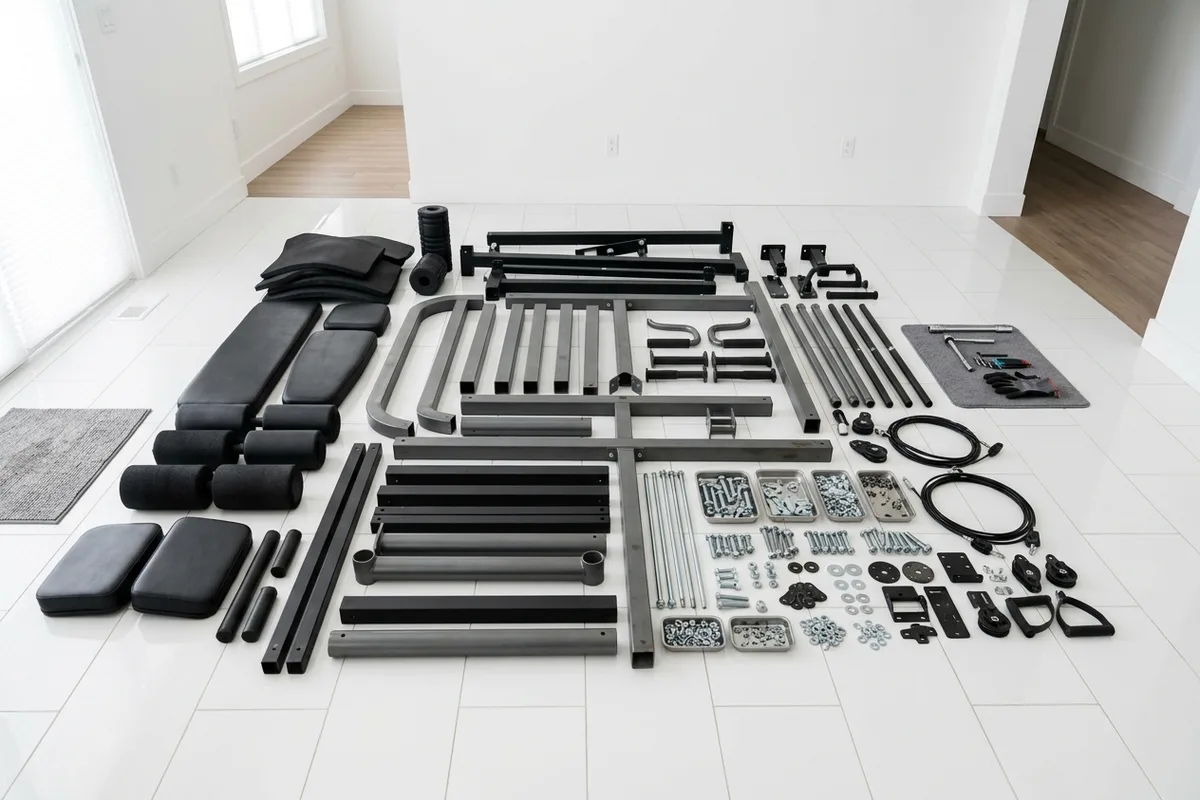
Dismantling is usually necessary. The cage comes apart into upright posts, cross-members, and a pull-up bar, but every bolt is structural and under load from the user's bodyweight during use, so they can be tight. A socket set and an adjustable spanner are the minimum tools needed, and the floor anchors leave holes that may need filling before a handover inspection.
Free Weights: Plates, Dumbbells, and Barbells
Cast-iron weight plates are the densest domestic objects most people own. A modest home set — a barbell, a pair of adjustable dumbbells, and a rack of standard plates — can easily total 150 kg. A serious set doubles that. The plates are small individually but there are many of them, and each one must be removed from its tree or rack, carried separately, and loaded in a way that does not overload one side of the vehicle.

Multi-Station Gyms and Cable Machines
A multi-gym — the all-in-one frame with a weight stack, cables, pulleys, and multiple exercise stations — is the most involved item to remove. It was assembled in the room from dozens of steel tubes and hardware, and it comes apart the same way. The weight stack alone (a column of rectangular cast-iron plates threaded onto a guide rod) is a concentrated load that has to be stripped plate by plate before the frame can be moved. Cable routing through pulleys means the cables have to be released in the right sequence to avoid a snap-back.
Rubber Matting and Floor Protection
Gym matting deserves its own mention because it is often forgotten during a quote. Interlocking rubber tiles lift and stack, but rolled rubber matting — the kind laid wall-to-wall in a dedicated gym room — is heavy, stiff, and has usually left marks or adhesive residue on the floor beneath it. In a rented property, the matting has to come up before a handover inspection, and the floor beneath may need cleaning or minor repair.
Matting is bulky relative to its weight and awkward to carry through doorways when rolled. Two people rolling from one end while a third guides the roll through the door is the practical approach, and the rolled mat goes into the vehicle last because it fills the remaining space above the denser items.
Apartments Versus Villas: The Access Difference
In a villa, the gym is typically in a ground-floor room, a converted garage, or a covered terrace area. Vehicle access is usually close, the route is short, and there is no lift to negotiate. The job is primarily about weight — enough hands to carry the load safely over a short distance.
In a tower apartment, the job changes. A treadmill that weighs 120 kg has to travel down a corridor, into a service lift, through a loading bay, and onto a vehicle. The service lift has a weight limit posted on the inside wall, and a full set of gym equipment can approach or exceed it in a single trip. That means multiple trips, which means booking the lift for longer. Building management may also require a deposit against damage in the common areas, particularly if heavy steel parts are being moved through marble-floored lobbies.
What to Do Before Collection Day
- **Strip the weight.** Remove all plates from bars, racks, and machines. Stack them in a single location near the equipment, not scattered across the room.
- **Unplug everything.** Treadmills, ellipticals, rowing machines, and any machine with a digital console. Tape the power cord to the frame so it does not trail during the carry.
- **Note the floor anchors.** If a rack or cage is bolted to the floor, say so when booking. Anchor removal takes longer than unbolting a frame, and a regular hand-carry crew may not have the right drill bit.
- **Measure the route.** Check the narrowest point between the equipment and the vehicle — usually the apartment front door or the service-lift door. A folded treadmill standing upright may clear a doorway that it cannot pass through lying flat.
- **List everything.** Include the matting, the accessories (resistance bands, kettlebells, foam rollers, pull-up bars clamped to door frames), and anything stored under or behind the main machines. Items added at the door change the estimate.
Resale Versus Disposal: When Equipment Still Has Value
Gym equipment holds its value better than most household items, provided it is functional and in reasonable condition. Cast-iron weight plates in particular are almost commodity items — they are bought and sold by weight, and rust is cosmetic rather than structural. A well-maintained treadmill from a recognised brand is worth listing; a budget treadmill whose belt has slipped and whose console no longer responds is not.
The practical test is whether you would use it if you were not moving. If the answer is yes and the item works, listing it is worth the effort. If the answer is no, or the item has been unused for long enough that the belt has seized or the cables have frayed, collection for disposal is the honest route.
What Happens to Gym Equipment After Collection
Steel-framed equipment is separated into ferrous metal at end of life. The steel tubes, plates, and hardware are genuine scrap-metal value. The rubber matting, foam padding, and plastic console housings are lower-value materials and are typically handled as general waste. A motorised treadmill's electronic components — the motor controller, the console board — are classed as e-waste and are directed to the appropriate stream, on the same basis as any other electronic appliance.
The weight of gym equipment works in its favour at end of life. Steel-heavy items have a higher recovery value per unit than bulkier, lighter household waste, which is one reason gym equipment is straightforward to have collected rather than left for a general clear-out.