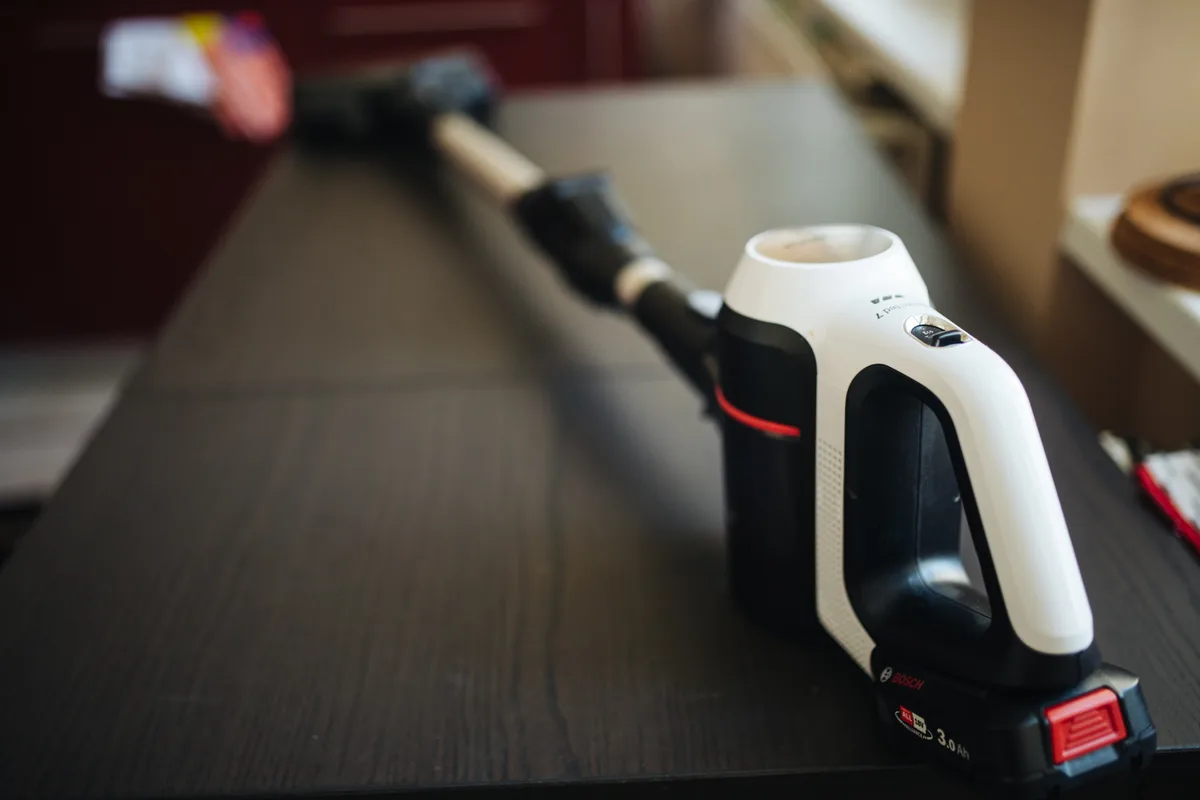
A vacuum cleaner is the one appliance in the house guaranteed to be full of something when you retire it. Emptying it properly comes before anything else, and after that its power source decides the rest of the job: a corded machine is a motor and a dust path, while a cordless stick or a robot is a battery product that must not travel in a bag of ordinary household waste.
Empty it before it leaves the house
Do this on a balcony, in a service corridor or over a bin liner held closed around the machine — not over an open kitchen bin. A vacuum's contents are fine dust, hair and grit, and a bagless bin releases most of it back into the air the moment the flap drops open. In a sealed, air-conditioned apartment that dust has nowhere to go except onto the surfaces you have just cleaned.
- Bagged machines: take the bag out whole, tape the collar shut and bin it. There is no reason to open it.
- Bagless machines: hold the bin low inside a liner and release it slowly, then tie the liner before carrying it anywhere.
- Filters: pull out the foam pre-filter and the pleated or HEPA cartridge and bin them with the dust. A used filter has no resale or recycling value and holds the worst of what the machine collected.
- Brush bar: cut away the wound hair and thread with scissors. It takes two minutes and spares whoever handles the head next.
If the machine has been sitting in a store room for a year, treat the contents as stale rather than merely dusty, and keep the emptying away from anyone in the household who reacts badly to dust.
The power source decides how it is handled
Corded uprights and cylinder machines
A corded vacuum is straightforward electrical waste: a motor with copper windings, a steel or moulded plastic body, a floor head, and several metres of copper-cored cable. Wind the cable and secure it against the body so it cannot trail on a stairwell, and keep the hose, wands and floor tools with the machine. They belong to the same item, and separating them only creates small parts that go missing between the door and the vehicle.
Cordless sticks, handhelds and robots
These are lithium battery products first and vacuums second. Leave the pack seated in the machine unless the manufacturer treats removing it as a normal user step — a pack loose in a box is more likely to short against something than one still in its housing. Say clearly when you book that the item is battery-powered, because that single word changes how it is packed and where it goes.
If a pack is swollen, unusually hot, leaking or has taken a hard fall, stop charging the machine, keep it away from anything flammable and mention the damage when you arrange the collection rather than on the doorstep. Do not attempt to prise a swollen cell out of its housing.
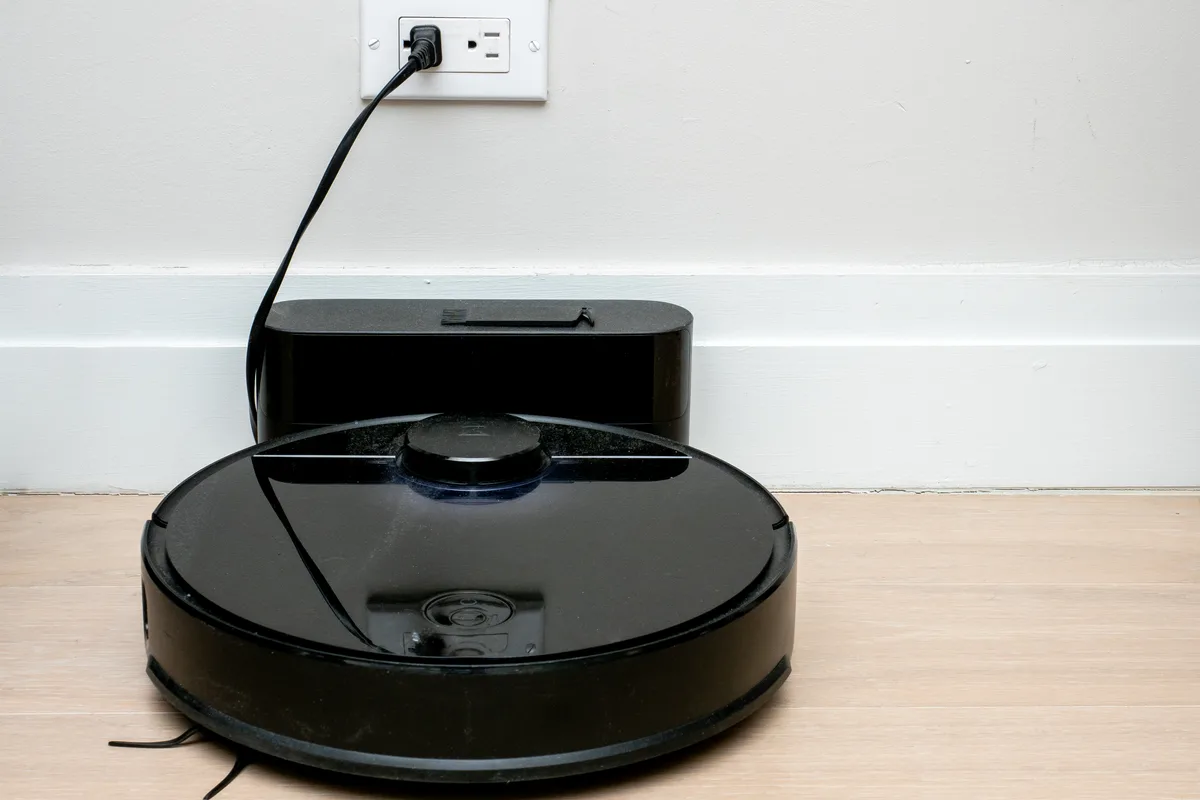
A robot also comes with a dock, a power supply and often spare side brushes and filters. Send the dock and adapter with the robot; on their own they are neither useful nor separately recyclable in any practical sense.
Wet-and-dry vacuums arrive with liquid in them
Workshop and garage machines are the exception to everything above. Drain the tank completely, take out the foam sleeve used for wet pick-up, and leave the drum open to dry for a day before the collection. Dirty water is heavy, it moves when the drum is tilted onto a trolley, and a lift floor is the worst possible place to discover how much of it was still inside.
A fitted central vacuum system is a different job
Some villas have a fitted central vacuum system: a power unit in the garage or a service cupboard, rigid tubing run inside the walls, and inlet points in individual rooms. Only the power unit, the hose and the tools are removable in any ordinary sense — the tubing and the wall inlets are part of the building. Treat the power unit the way you would treat a water heater: confirm whether it is yours to remove before booking anything, and expect the wall points to stay where they are.
Is it worth passing on rather than scrapping?
A vacuum has second-hand value only as a complete working set, and the bar is higher than people expect. Four things have to be true at once.
- It starts and holds suction with a clean filter fitted.
- The hose and at least the main floor head are present and uncracked.
- A replacement filter or bag for that model is still obtainable.
- The cable and plug are undamaged along their whole length.
Miss one of those and it is a recycling item, not a donation. A machine that needs a part nobody stocks any more is a burden to whoever accepts it, and passing that on is not a favour.
Booking the collection
One vacuum on its own is a small job, so it usually travels best alongside other electronics or as an addition to a collection already booked for larger items. When you describe it, say what kind of machine it is rather than calling it a small appliance: “corded upright, working” and “robot vacuum with dock, battery inside” lead to two different answers about handling, and the second one matters.
An old vacuum is an easy thing to leave in a store room for another year. It takes about ten minutes to empty, strip the filters from and make ready — after which it is simply one line on a collection request, and the cupboard it was occupying is free.