Most armchairs leave a home on their own. The sofa went when the living room was redone and the odd chair stayed behind, or the chair came with a furnished flat, or it has spent two years in a bedroom corner being sat on by nobody. However you arrived at it, you have one upholstered chair to deal with and no obvious way to judge it. Armchair disposal in Dubai turns on a question the fabric cannot answer: whether the timber frame inside is still sound. That one fact decides whether the chair is worth re-covering, worth offering to somebody, or genuinely finished.
An armchair is upholstered furniture wearing a chair's name
This is worth settling first, because it changes what you ask for. A dining chair is carried under one arm. An armchair is a two-person item with a sofa's depth and a sofa's stuffing, and it is quoted and handled as upholstered furniture rather than as seating.
The practical difference is that an armchair does not get smaller. Hard chairs fold, stack or nest; an armchair arrives at the door exactly the size it is, and the number that decides whether it fits is its depth from the front of the seat to the back of the frame, not the width people instinctively measure. Wing chairs and deep club chairs are the ones that surprise people, because the back is often taller than a chair has any business being.
One armchair in a lift is a short job. Getting it down a stairwell is not, and that is worth mentioning when you ask for a price rather than discovering it on the landing.
How to judge a frame you cannot see
You cannot rock an armchair the way you would test a wooden dining chair, because the upholstery hides the joints and the padding absorbs the movement. Three tests get you most of the way instead, and none of them needs a single staple removed.
- Sit right on the front edge of the seat, not back in it. The front rail is the most heavily loaded piece of timber in the chair, and a frame that has begun to fail will creak, drop or flex under your weight there when it feels perfectly solid further back.
- Lift the chair by one arm, a few centimetres only. A sound chair comes up as one object. If the arm rises before the rest of the chair does, or the whole thing twists as it leaves the floor, the joints have loosened and the frame is moving inside the cover.
- Push down on each arm from above. An arm that gives, or that meets the seat with a visible gap where the fabric has pulled apart, has usually broken where it is fixed to the frame — the most common failure in an armchair and the one people mistake for worn padding.
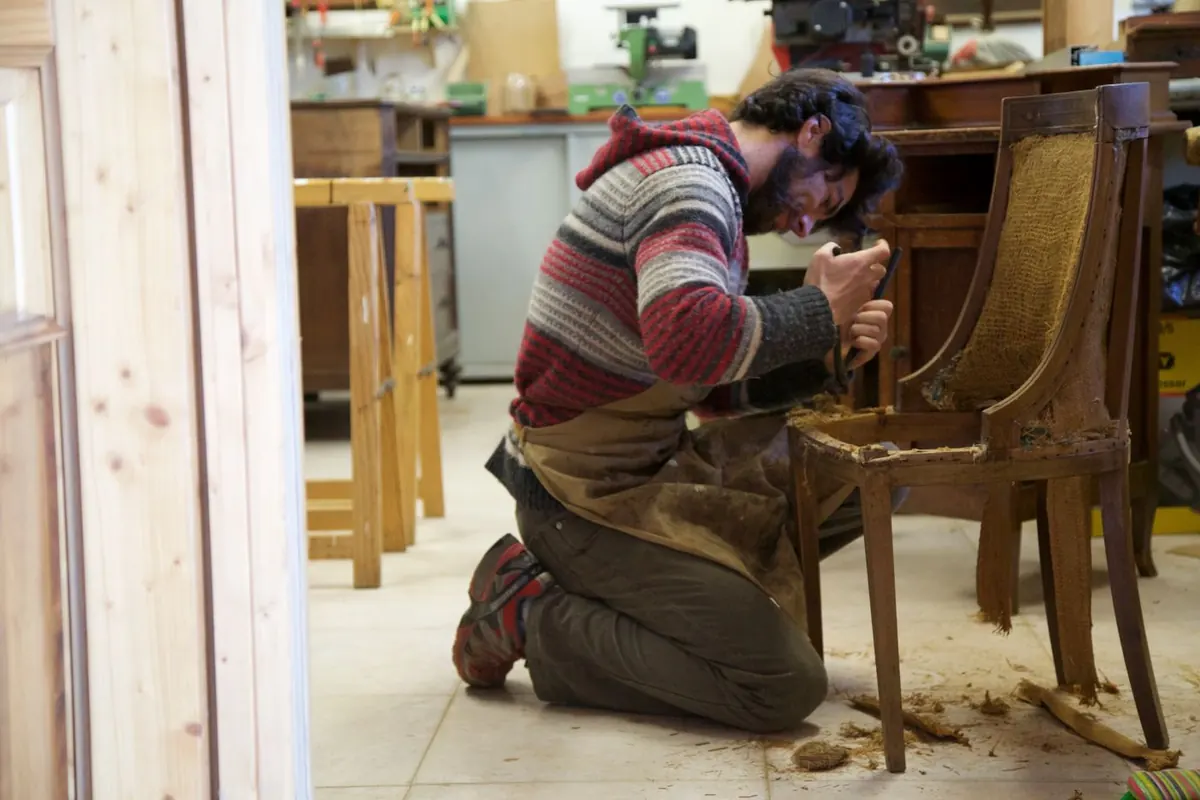
What the fabric tells you is a much shorter list. Fading, flattened cushions and worn arms are cosmetic and say nothing about the frame underneath. A tear that goes right through to the webbing tells you the chair has been used hard, which is a hint rather than a verdict. The one honest exception is water: a chair that has been soaked, whether from a leak or a bathroom overflow, is a different case, because the foam holds moisture long after the surface feels dry.
When re-covering is the better answer than replacing
An armchair is the one upholstered item in most homes where re-covering is a realistic alternative to disposal. Upholstery is a working trade in this city rather than a specialist rarity, and a single chair is a small enough job to be worth quoting — which is not true of a three-seater and its matching sofa.
Whether it is worth doing comes back to the frame. A chair that passes all three tests above is a chair where you are paying for labour, foam and fabric on top of a structure that is still good. A chair that fails them is a chair where the frame work has to happen first, and at that point you are rebuilding rather than re-covering.
Two things rule it out regardless. Slim accent chairs built from foam moulded over a plywood or moulded shell have no frame to save — the shape is the structure, and it cannot be re-covered in the ordinary sense. And a chair with no sentimental or design value attached to it is usually not worth the exercise, because the cost of the work does not care whether the chair underneath was expensive. Get the work quoted before you decide, and compare it honestly against what replacing the chair would cost you.
Which armchairs actually find a second home
An armchair has the opposite placement problem to a dining chair. A dining chair has to match three others to be wanted. An armchair was bought as one and is wanted as one, so a single good armchair genuinely moves — people furnishing a first apartment want exactly one comfortable seat, and a spare bedroom or a study rarely has room for anything larger.
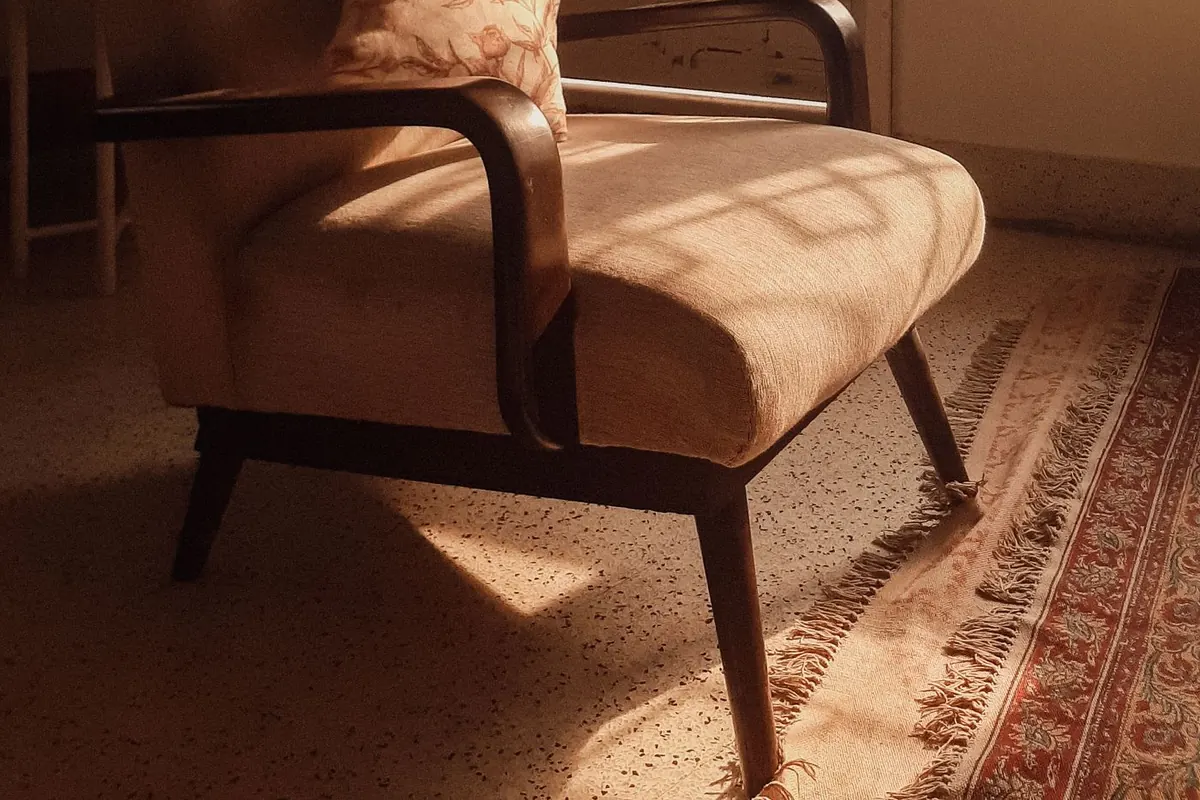
What stops one moving is almost never the number. It is the fabric and the transport. Fabric ages where everyone can see it, so a chair with a marked seat and greyed arms is difficult to give away however sound it is underneath. And whoever takes it has to collect it, which means an armchair usually goes to somebody within the same building or the same community long before it goes to a stranger across the city.
If a chair is sound and presentable, photograph it in daylight against a plain wall, give the depth as well as the width, and say whether the legs unscrew. If it is sound but tired, offering it free tends to move it faster than pricing it low, because the people who will actually turn up with a car are the ones who were not going to pay much anyway.
Armchair disposal: what happens to the chair afterwards
An armchair that is finished is collected as bulky furniture rather than separated into materials, and it is worth being straightforward about why. Inside the cover there is a timber frame, webbing or springs, foam, wadding and the outer fabric, and those are stapled, tacked and glued together rather than assembled with fittings that can be undone. Taking one apart is destructive work that produces small quantities of mixed material, which is why a single household chair is handled as a whole item.
That has one practical consequence when you book. An armchair is bulky rather than heavy, so it is priced on the space it takes up on the vehicle, and it takes up roughly what it takes up standing in your living room. If other things are going at the same time, sending them together is considerably cheaper than a separate visit for one chair.
The chairs people call armchairs that are a different job
Three things get described as armchairs when they are booked and need flagging separately, because each changes something on the day.
A recliner is not an armchair with a footrest. It carries a steel mechanism inside the base, and a powered one carries a motor and a transformer as well, so part of it is electrical rather than furniture. Say so when you book — the handling and the routing both change.
A swivel or glider chair has a rotating base plate, and a gas-lift column if it came from a study rather than a nursery. Neither is dangerous, but neither should be forced apart at home.
And a woven or rattan chair from a terrace belongs with the outdoor furniture rather than with the indoor upholstery. Sun changes what those materials can take, and a chair that has spent three summers outside can fail while it is being lifted rather than while it is being sat on.
None of this takes long. Sit on the front edge, lift it by one arm, and you will know within a minute which conversation you are having — a quote from an upholsterer, a photograph for the building group, or a collection. The chairs people regret are the ones that sat in a spare room for another year while nobody made that decision.