A fridge that is being moved is a fridge you intend to keep, and that changes what a successful move looks like. Nobody judges the job by whether the machine reached the new kitchen without a scratch. It is judged a week later, by whether it is still holding temperature. Almost everything that decides that happens in two places most people never think about: the angle it travelled at, and how soon it was switched on afterwards. If the old unit is not making the move at all, appliance removal in Dubai is the separate job.
What actually goes wrong when a fridge is moved
Three things account for most fridges that stop working after a move, and only one of them is a handling accident. If the fridge is not being kept, the job is different: see how to dispose of a fridge in Dubai.
- The compressor oil moves. The compressor sits in a small reservoir of oil at the bottom of the machine. Tip the machine over and that oil runs where it was never meant to go, into the narrow tubing of the sealed cooling circuit.
- The machine is switched on too soon. Running the compressor while oil is still sitting in the circuit is what turns a survivable tilt into a dead fridge.
- The door or its seal is damaged. A strap pulled hard across a door panel, or a hinge taking the weight during a carry, leaves a door that no longer closes squarely, and a fridge that cannot seal cannot hold temperature.
Dents and scuffs are a fourth category and they are the one nobody needs advice about. The first two are the dangerous ones precisely because they leave no mark. A fridge with oil in the wrong place looks exactly like a fridge that travelled perfectly, right up until it does not get cold.
Empty it, defrost it and let it dry
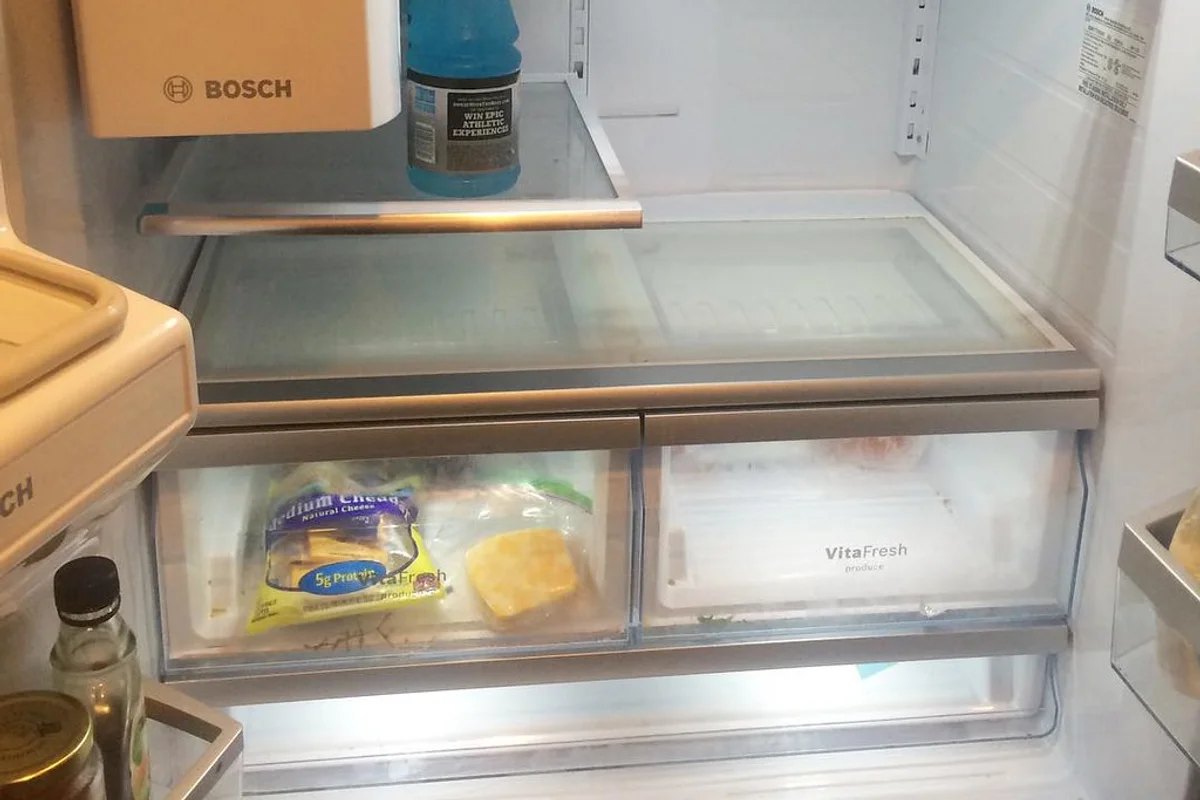
A fridge that is being moved needs to leave dry, not just empty. Water is the reason. Every fridge holds meltwater somewhere once it warms up, in a drip tray, in the base of the freezer compartment, or simply as condensation running down the back wall, and it will find the floor at some point between the kitchen and the vehicle.
For a move across town, unplugging the night before is usually enough for a fridge compartment. A freezer section with real ice in it needs longer, and it needs a towel underneath while it goes. The detailed defrost-and-meltwater routine that a disposal collection asks for is its own subject; for a move, the practical target is simply that nothing is dripping when the machine is tilted onto a trolley.
Wipe the inside dry and leave the doors ajar until it is loaded. A sealed damp fridge standing in a warm flat for a day develops a smell that takes far longer to remove than the drying would have taken.
Why a fridge travels upright
A fridge travels standing up because its compressor oil has to stay in the compressor. That is the whole of the reason. The oil sits in a sump at the base of the machine, the sealed circuit above it carries refrigerant and nothing else, and gravity is the only thing keeping those two facts true.
There is a real difference between tilting and laying down. Leaning a fridge back to slide a trolley underneath, or angling it through a doorway for a few seconds, is normal handling and no machine is designed to fail at it. Laying one flat in the back of a vehicle for a forty-minute drive is a different act, because the oil has both the angle and the time it needs to migrate.
In the vehicle, that means upright and strapped to a side rail or bulkhead rather than free-standing, with something soft between the strap and the door. A fridge that is standing but able to rock is not really upright at all.
If it genuinely has to be laid down
Sometimes there is no vehicle available that will take a tall fridge standing up, and the honest answer is that laying it down is a compromise rather than a disaster. Keep the time short, keep it on its side rather than on its front or back, and treat the settling period afterwards as compulsory instead of optional.
The rule of thumb that installers work to is straightforward: leave it standing for at least as long as it spent lying down, and longer if the journey was hot. Where the manufacturer's manual names a preferred side to lay a particular model on, follow that in preference to any general advice, because the layout of the tubing differs between machines.
Doors, shelves and the tightest point on the route
Doors are held shut with a strap that goes right around the body of the machine, not with tape across the join. In a Dubai summer that is not a preference. Adhesive tape on a warm painted door softens, slides and leaves a residue that then bakes on, and it holds badly at exactly the moment the door is most likely to swing open.
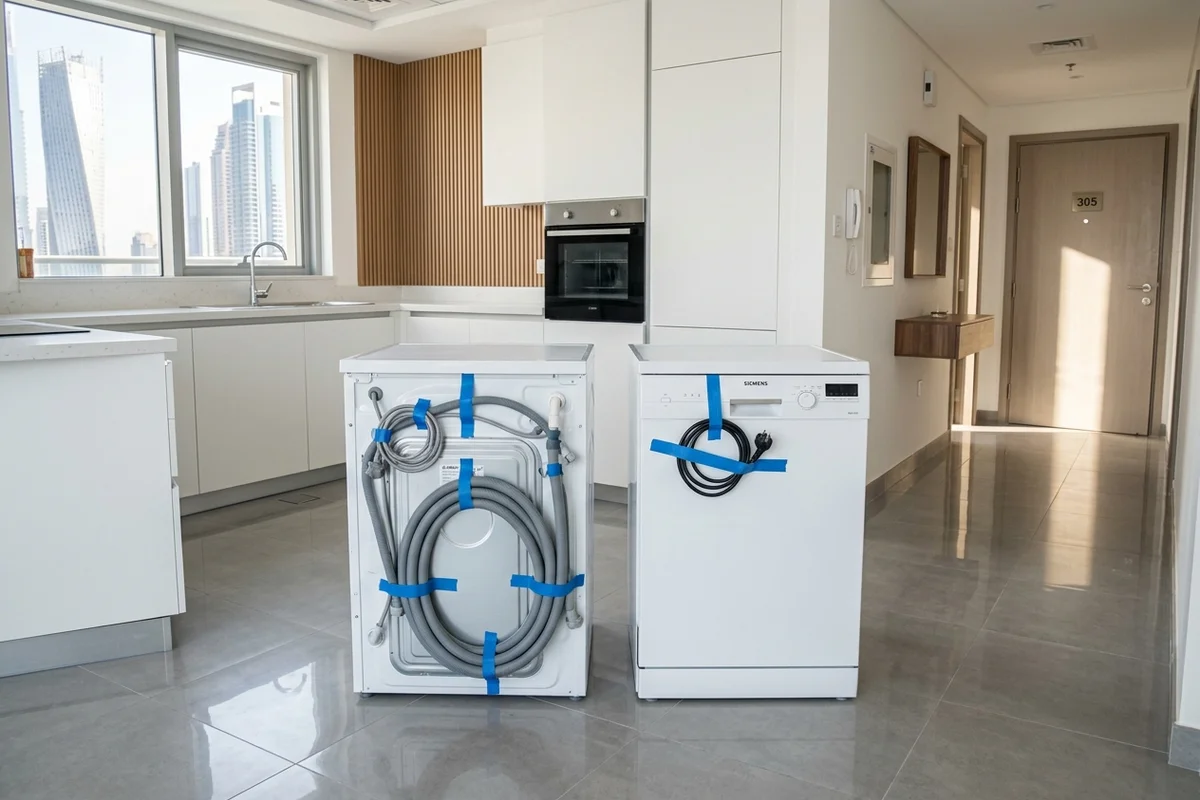
Shelves and drawers are going back into this fridge, so they travel separately and padded rather than rattling inside it. Glass shelves in particular are safer flat in a car boot than loose in a machine being carried down a stairwell. Unplug and coil the cable, and tie it to the back of the machine so it never ends up under a trolley wheel.
Measure the fridge, then measure the narrowest point on the route rather than the kitchen doorway. In a tower that is usually the flat's entrance door or the lift car; in a villa it is more often a turn in a corridor than a door width. Both ends of the move need checking, because the new kitchen has its own gap and its own approach.
The vehicle, and the heat inside it
A closed van standing in the sun in Dubai gets considerably hotter than the air outside it, and a fridge parked in one for two hours arrives soft rather than merely warm. That is not a problem for the sealed system, which is not running, but it is a problem for everything made of plastic: door liners, shelf trims and the strip along the bottom of the door all mark far more easily when they are hot.
The fix is scheduling rather than equipment. Load the fridge last and unload it first, keep the leg short, and avoid leaving it sitting in a loaded vehicle over the middle of the day. If the move is happening across a summer afternoon, the fridge is the item worth doing early.
Let it stand before you switch it on
A fridge should stand upright in its final position for several hours before it is plugged in, and considerably longer if it travelled on its side. This is the step that gets skipped, because by the time the machine is in place everyone involved wants the job to be finished.
The reason is the same oil. Standing still lets whatever moved during the journey drain back down to the compressor, and starting the compressor before that has happened is what causes the failure. Waiting costs an evening. Not waiting can cost the fridge.
- Stand it in its final position first, so it is not moved again after settling.
- Leave a hand's width of clearance behind and above it. A fridge pushed hard against a wall in a hot kitchen runs longer and works harder for the rest of its life.
- Plug it in empty and let it run a full cooling cycle with the doors closed before anything goes in.
- Load it gradually. Filling a just-started fridge with warm shopping gives it the hardest possible first day.
A newly moved fridge often runs loudly and almost continuously for the first day or so, which is normal while it pulls an empty warm cabinet down to temperature. What is not normal is a machine that is still running constantly after several days without getting cold, and that is the point at which it needs looking at rather than waiting on.
When a fridge is not worth moving at all
Moving a fridge is worth the trouble for a machine with years left in it. It is often not worth it otherwise, and being honest about that in advance saves a difficult afternoon.
- It is already noisy, icing up unevenly or struggling to hold temperature. A move will not improve any of those.
- It was built into the old kitchen. An integrated unit rarely fits the next set of cabinetry, and it is a poor freestanding fridge once it is out.
- It is a large American-style two-door machine going into a flat with a tight lift and a narrow entrance hall.
- You are leaving the country. Shipping a fridge that has already worked through several Dubai summers is one of the least rewarding uses of a container's space.
At that point the question changes from how to move it to how to get rid of it, and so does the preparation, because a fridge going for disposal has a sealed refrigerant circuit that has to be dealt with by someone qualified rather than simply switched off.
The measure of a fridge move is not the day it happens. Keep it upright, keep it dry, strap the doors rather than taping them, and then leave it alone for an evening before you plug it in. The last of those costs nothing and is the one most often skipped, which is exactly why it is the one worth remembering.