
There is no single set of furniture disposal rules in Dubai, which is exactly why searching for one is frustrating. The rules that genuinely apply to you come from four separate places — the waste system, your building or community, your tenancy contract, and whoever you hire to carry the item away — and they sit in four different documents, none of which is titled anything like “furniture disposal rules”. This guide sets out what each one actually governs and where to read it.
The four places the rules come from
In rough order of how likely each is to affect you in practice.
- The waste system. Furniture is not household waste, so the everyday collection your building already runs does not cover it.
- Your building or community. This is the layer with real teeth — house rules govern how, when and through which entrance anything large leaves, and management is the party that will actually contact you.
- Your tenancy. This decides what is yours to dispose of in the first place, and it is the rule that costs the most when it is broken.
- The operator you hire. Whoever takes the item away needs to be licensed to carry it and to dispose of it properly, which matters to you as well as to them.
None of the four requires guesswork. Each has a document or a person behind it, and all four can be checked in an afternoon.
Furniture is not household waste
The everyday waste system in a residential building is built around containers — bags into bins, bins onto a truck with a lifting mechanism. A sofa never enters that system at any point, so leaving one beside the bins does not put it into a queue. It stays there until somebody specifically arranges to take it, blocking the bin area in the meantime.
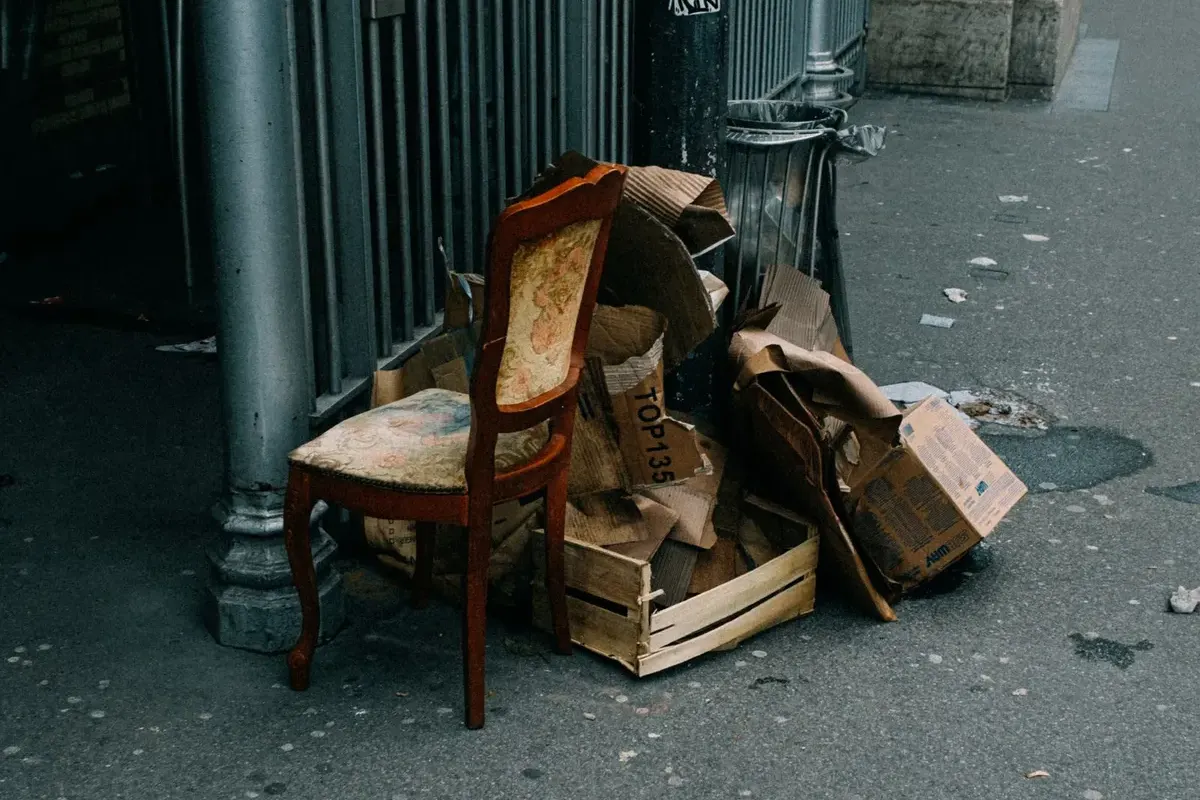
That is the whole of the first rule, and it applies equally in a tower, a townhouse and a villa: anything bulky needs an arranged collection rather than a bin.
Your building's rules are the ones with teeth
If any rule is ever enforced against you over a furniture collection, it will almost certainly be your building's or your community's. It is the only one of the four with somebody on site, a record of which unit you live in, and a direct reason to care.
These rules exist in nearly every managed building here, and most residents have never read them. They usually sit in one of four places.
- The handover pack or welcome documents given to you when you moved in.
- A community handbook or house rules document, available from the management office or an owners' portal.
- Notices by the lift lobby or the service entrance, which is where temporary changes appear.
- The building manager or management office directly — the fastest route, and the one most people skip.
What they cover is fairly predictable: which entrance and which lift large items may use, the hours that is allowed to happen in, whether management needs advance notice, and what a contractor must show before being let in. The specifics vary from one building to the next, which is why reading yours beats assuming the tower next door works the same way.
A short message to building management with your intended date and a one-line description of what is leaving costs nothing and settles most of this in advance.
Not everything in the flat is yours to dispose of
This is the rule that costs real money, and it has nothing to do with waste. Furnished and part-furnished lets are common here, and furniture that came with the property belongs to the landlord rather than to you.

Three categories are worth checking before anything is booked.
- Anything on the inventory attached to your tenancy contract. That list, not your memory of the flat, is what a check-out inspection works from.
- Anything fixed to the building — fitted wardrobes, built-in desks and shelving, kitchen and vanity units. Removing one leaves fixings and bare patches behind, which makes it an alteration to the property rather than a clear-out.
- Items left behind by a previous tenant, which are neither clearly yours nor clearly the landlord's until somebody confirms which.
The fix is the same in all three cases and it is not complicated: agree it with the landlord or the managing agent in writing before the collection is booked. Replacing a wardrobe that was never yours to remove costs considerably more than the collection did.
Whoever takes it away has to be allowed to
The fourth rule is about the vehicle rather than the flat. A furniture load has to end up somewhere legitimate, and the operator carrying it needs to be licensed for that work.
The reason this concerns a resident and not only a company is straightforward: an item dumped where it should not be is traceable, and the trail runs back through the building that released it to the unit it came from. Choosing on price alone is where that risk enters a job.
Checking is a short conversation rather than an investigation. Ask to see the trade licence, ask where the load actually goes, and treat an answer that avoids both as the answer.
Items that do not travel in a furniture load
A few things commonly cleared alongside furniture follow their own route, whoever is driving.
- Anything holding refrigerant — a fridge, a freezer, or a window or split air-conditioning unit.
- Anything with a battery in it, including a motorised bed base or a powered recliner.
- Gas cylinders, including barbecue bottles left on a balcony or in a store room.
- Paint, solvents and cleaning chemicals from a storeroom or utility cupboard.
Flag these when you book rather than on the day. Arranging a route for them in advance is simple; arranging one while a crew stands waiting is not.
Checking your own situation
Five steps, in this order, cover everything above.
- Read the inventory attached to your tenancy contract and mark anything on it that you were planning to get rid of.
- Find your building's or community's house rules and look for the sections on moving, deliveries and contractors.
- Message building management with your intended date and what is leaving, and ask what they need from you and from the crew.
- Confirm the operator is licensed and ask where the load goes.
- Book the collection once the first four are answered, rather than before.
In a villa community the same five steps apply, with the middle two pointing at community management rather than a building manager. Access is easier there, but the rules about altering the property and about who may work on site are often stricter, not looser.
The reason a search for furniture disposal rules in Dubai returns so little that is useful is that the question assumes one authority where there are four, most of them contractual rather than public. Read your tenancy inventory, find your building's house rules, tell management the date, and use an operator who can say where the load goes. That covers almost everything anyone is likely to hold you to, and none of it takes longer than an afternoon.